Planet of the Month
VENUS
Even though Venus isn't the closest planet to the sun, it is still the hottest. It has a thick atmosphere full of the greenhouse gas carbon dioxide and clouds made of sulfuric acid. The gas traps heat and keeps Venus toasty warm. In fact, it's so hot on Venus, metals like lead would be puddles of melted liquid.
Venus looks like a very active planet. It has mountains and volcanoes. Venus is similar in size to Earth. Earth is just a little bit bigger.
Venus is unusual because it spins the opposite direction of Earth and most other planets. And its rotation is very slow. It takes about 243 Earth days to spin around just once. Because it's so close to the sun, a year goes by fast. It takes 225 Earth days for Venus to go all the way around the sun. That means that a day on Venus is a little longer than a year on Venus.
Since the day and year lengths are similar, one day on Venus is not like a day on Earth. Here, the sun rises and sets once each day. But on Venus, the sun rises every 117 Earth days. That means the sun rises two times during each year on Venus, even though it is still the same day on Venus! And because Venus rotates backwards, the sun rises in the west and sets in the east.
Just like Mercury, Venus doesn't have any moons.
Structure and Surface
- Venus is the hottest planet in our solar system.
- Venus is a terrestrial planet. It is small and rocky.
- Venus has a thick atmosphere. It traps heat and makes Venus very hot.
- Venus has an active surface, including volcanoes!
- Venus spins the opposite direction of Earth and most other planets.
Time on Venus
- A day on Venus lasts 243 Earth days.
- A year on Venus lasts 225 Earth days.
Venus's Neighbors
- Venus does not have any moons.
- Venus is the second planet from the Sun. That means Mercury and Earth are Venus's neighboring planets.
Quick History
- Venus has been known since ancient times because it can be seen easily without a telescope.
- Venus has been visited by several spacecraft: Mariner 2, Mariner 5, Mariner 10, Pioneer Venus 1, Pioneer Venus 2, and an orbiter called Magellan.
What does Venus look like?
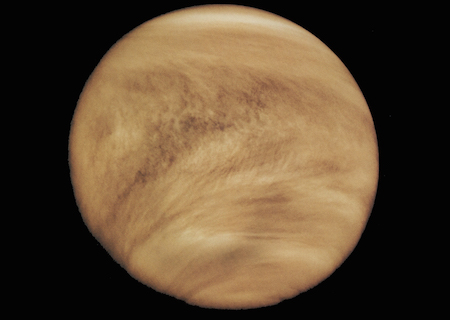
Here you can see the clouds covering Venus.
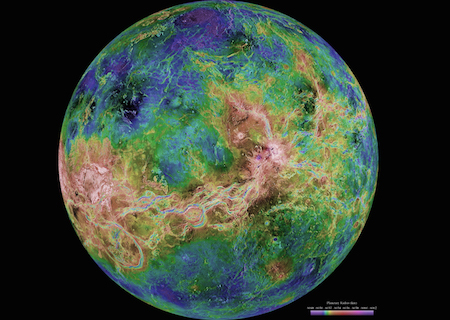
This is a combination of images taken by the Magellan spacecraft. The colors have been altered so you can see all the differences in Venus's surface. Magellan used radar to get information about the surface of Venus, which we can't normally see because of the thick, cloudy atmosphere.
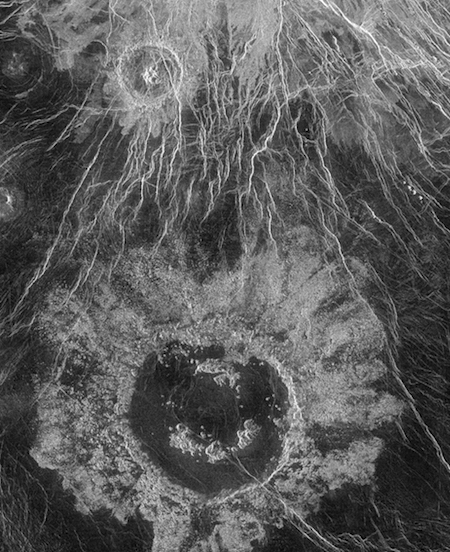
A crater on the surface of Venus. It's 45 miles (72 km) wide.
EARTH-SIZED
If the sun were as tall as a typical front door, the Earth and Venus would each be about the size of a nickel.
SECOND ROCK
Venus orbits our Sun, a star. Venus is the second closest planet to the sun at a distance of about 67 million miles (108 million km).
A DAY LONGER THAN A YEAR
One day on Venus lasts 243 Earth days because Venus spins backwards, with its sun rising in the west and setting in the east.
CHASING CLOUDS ON VENUS
DIVERSE TERRAIN
Venus' solid surface is a volcanic landscape covered with extensive plains featuring high volcanic mountains and vast ridged plateaus.
MOONLESS AND RINGLESS
Venus has no moons and no rings.
GREENHOUSE EFFECT
The planet’s surface temperature is about 900 degrees Fahrenheit (465 degrees Celsius)—hot enough to melt lead.
WATER ON VENUS
Many scientists believe water once existed on the surface. Future Venus explorers will search for evidence of an ancient ocean.
MANY VISITORS
More than 40 spacecraft have explored Venus. The ‘90s Magellan mission mapped the planet's surface and Akatsuki is currently orbiting Venus.
LIFE ON VENUS
Venus’ extreme temperatures and acidic clouds make it an unlikely place for life as we know it.
SUPER ROTATING ATMOSPHERE
While the surface rotates slowly, the winds blow at hurricane force, sending clouds completely around the planet every five days.
VENUS - 3-D PERSPECTIVE VIEW OF SAPAS MONS
Did You Know?
The Soviet Union’s Venera 13 survived the intense heat and crushing pressure of Venus’ surface for more than two hours. Engineers from several nations are currently studying methods to extend the life of robotic spacecraft in the extreme environment.
Pop Culture
Named after the goddess of love and beauty, Venus has become nearly synonymous with "woman" in popular culture, as referenced by the famous relationship guide Men are from Mars, Women are from Venus. As a solar system locale, Venus was a popular destination for early 20th century science fiction writers; before we knew about what lay beneath Venus' mysterious cloud cover, writers could speculate about a more hospitable planet and its possible inhabitants.
More recently, Venus has been a backdrop for video games such as Transhuman Space, Battlezone and Destiny. And in the Disney animated film The Princess and the Frog, Ray the firefly falls in love with Venus, "the evening star," as he has mistaken it for another firefly.
Size and Distance
With a radius of 3,760 miles (6,052 kilometers), Venus is roughly the same size as Earth — just slightly smaller.
From an average distance of 67 million miles (108 million kilometers), Venus is 0.7 astronomical units away from the Sun. One astronomical unit (abbreviated as AU), is the distance from the Sun to Earth. It takes sunlight 6 minutes to travel from the Sun to Venus.
Orbit and Rotation
Venus' rotation and orbit are unusual in several ways. Venus is one of just two planets that rotate from east to west. Only Venus and Uranus have this "backwards" rotation. It completes one rotation in 243 Earth days — the longest day of any planet in our solar system, even longer than a whole year on Venus. But the Sun doesn't rise and set each "day" on Venus like it does on most other planets. On Venus, one day-night cycle takes 117 Earth days because Venus rotates in the direction opposite of its orbital revolution around the Sun.
Venus makes a complete orbit around the Sun (a year in Venusian time) in 225 Earth days or slightly less than two Venusian day-night cycles. Its orbit around the Sun is the most circular of any planet — nearly a perfect circle. Other planet's orbits are more elliptical, or oval-shaped.
With an axial tilt of just 3 degrees, Venus spins nearly upright, and so does not experience noticeable seasons.
Structure
Venus is in many ways similar to Earth in its structure. It has an iron core that is approximately 2,000 miles (3,200 kilometers) in radius. Above that is a mantle made of hot rock slowly churning due to the planet's interior heat. The surface is a thin crust of rock that bulges and moves as Venus' mantle shifts and creates volcanoes.
Formation
When the solar system settled into its current layout about 4.5 billion years ago, Venus formed when gravity pulled swirling gas and dust together to form the second planet from the Sun. Like its fellow terrestrial planets, Venus has a central core, a rocky mantle and a solid crust.
Comments
Post a Comment